Understanding Presbyopia
Why reading becomes difficult as we age, and the clinical options available to address it.
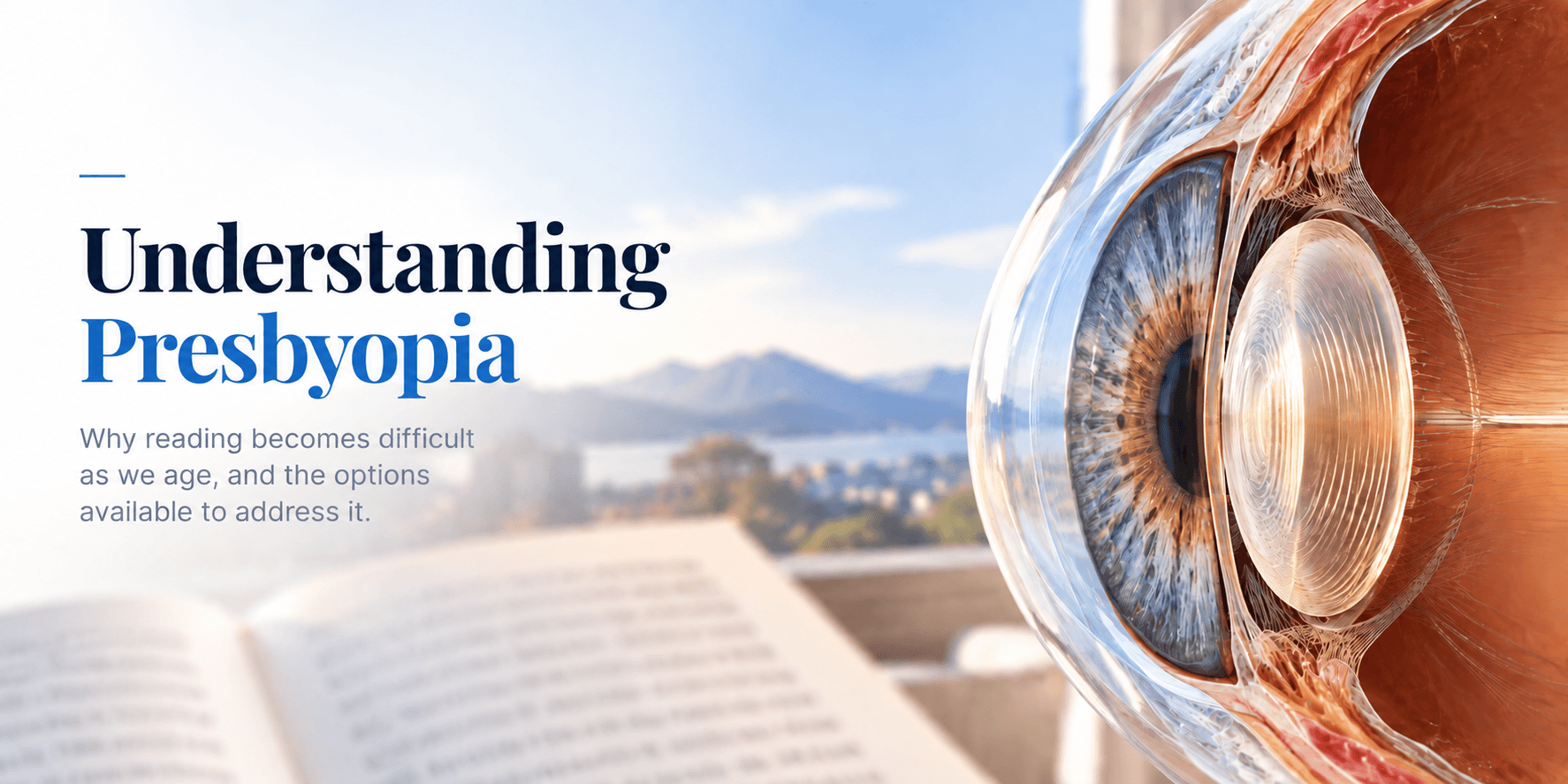
Presbyopia is not a disease; it is an entirely natural part of the aging process. As we enter our fourth decade, the crystalline lens inside the eye gradually loses its elasticity. The ciliary muscles, which shape the lens to focus on near objects, can no longer overcome this rigidity."},{"type":"h2","text":"The symptom progression"},{"type":"p","text":"The classic presentation involves pushing reading material further away to achieve focus. Eventually, patients require reading glasses or varifocals to function in daily life, especially in dim lighting conditions."},{"type":"h2","text":"Clinical interventions"},{"type":"p","text":"There are two primary paradigms for treating presbyopia surgically. The first involves altering the cornea using laser technology (such as PRESBYOND) to create a blended depth of focus. The second involves treating the root cause by removing the aging lens entirely and replacing it with a multifocal artificial lens (Refractive Lens Exchange)."},{"type":"p","text":"The choice between corneal and lenticular surgery depends heavily on the patient's exact age, the health of their natural lens, and their tolerance for neural adaptation."}]
Book an assessment to find out which options are safely suited for your eyes.
PRESBYOND 2.0
PRESBYOND 2.0 is an advanced laser treatment specifically designed to treat presbyopia, reducing the need for reading glasses.
Refractive Lens Exchange (RLE)
RLE replaces the eye's natural aging lens with a premium artificial lens, correcting vision and preventing future cataracts.
What is SMILE Pro 2.0?
The latest generation of lenticule extraction laser vision correction explained in plain language.
LASIK vs SMILE Pro: What is the difference?
Understanding the technical and anatomical differences between the two most popular laser vision procedures.